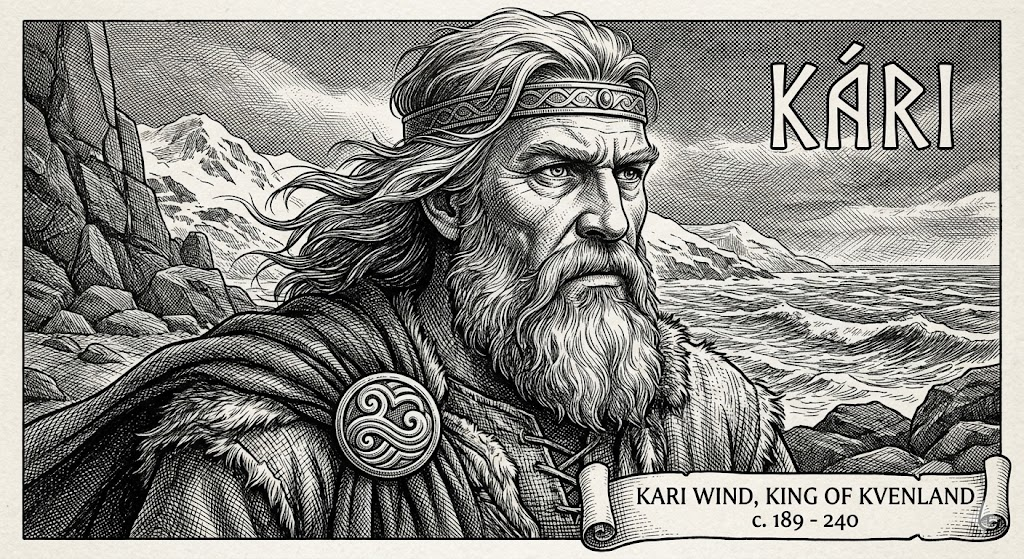
Kåre Fornjotsson King of Kvenland
Born 189 · Kvenland, Scandinavie · Died 240 · Kvenland, Scandinavie
Biological parents
No records listed yet.
Step parents
No records listed yet.
Siblings
No records listed yet.
Half siblings
No records listed yet.
Spouse(s)
No records listed yet.
Children
Biography and reference links
Kári “Wind” Fornjótsson: The Elemental King of Kvenland
In the fascinating crossroads where Norse mythology intersects with ancient Scandinavian genealogy, few figures are as prominent as Kári Fornjótsson, often remembered in genealogical records as Kari “Wind,” King of Kvenland. Sourced from the legendary sagas of the North and modern genealogical projects—which tentatively place his lifespan between roughly 189 and 240 AD—Kári serves as a bridge between elemental deity and mortal ancestor. Whether viewed as an ancient king or a personification of the wind, Kári Fornjótsson’s legacy is foundational to the mythic origins of the Nordic world.
Kári’s story begins with his father, Fornjót (Old Norse: Fornjótr), a towering figure in Norse myth described as an “ancient giant” (jötunn) and a primordial ruler of Finland, Kvenland, and Gotland. According to foundational texts like the Orkneyinga saga and Hversu Noregr byggdist (How Norway was Settled), Fornjót divided his power and legacy among his three sons, each representing a formidable force of nature. Kári’s brothers were Hlér (also known as Ægir), who ruled the seas, and Logi, who governed fire. Kári himself was the ruler and personification of the wind. This elemental trinity is further cemented in Snorri Sturluson’s Skáldskaparmál, which explicitly instructs poets to refer to the wind as the “son of Fornjót” and the “Brother of the Sea and of Fire.”
While his brothers were intrinsically tied to the ocean and the flame, Kári’s dominion over the wind seemingly translated into worldly rulership. In the saga accounts, Kári emerged as the heir to his father’s terrestrial kingdoms in the icy north. He took up the mantle as the King of Kvenland, a legendary realm situated around the northern reaches of the Baltic Sea, encompassing parts of modern-day Finland and northern Scandinavia.
In genealogical terms, Kári’s most significant contribution is his role as an ancient patriarch. Modern family tree platforms and genealogical societies trace an astonishing number of ancestral lines back to Kári’s reign. He was the father of Frosti (Frost), who in turn fathered Snær (Snow the Old). Snær’s son, Thorri, was a great king whose own children—Norr, Gorr, and Gói—drive the epic narrative of Scandinavia’s settlement. When Gói vanished, her brothers set out to find her; Gorr searched the islands, while Norr traveled across the mainland, subjugating territories and ultimately founding the nation of Norway (which translates to “Norr’s Way”). Thus, Kári Fornjótsson is revered not just as a king of Kvenland, but as the great-great-grandfather of Norway itself. According to texts like Hversu Noregr byggdist, Kári’s descendants eventually spread far beyond Kvenland and Finland, establishing royal lines in Sweden and, through subsequent Viking and Varangian expansions, across broader Europe.
Today, Kári Fornjótsson occupies a unique space in modern historical curiosity. Genealogical records, such as those found on Geni and Find a Grave, assign him mortal dates—born circa 189 AD and dying around 240 AD—anchoring the mythic king in the timeline of late antiquity. These dates are, of course, a speculative endeavor by later historians and genealogists attempting to ground saga folklore in a chronological reality.
Ultimately, Kári “Wind” Fornjótsson remains an immortal fixture of Scandinavian heritage. Whether he was a literal flesh-and-blood chieftain whose deeds were exaggerated into elemental godhood, or a purely mythological jötunn adopted into the pedigrees of medieval kings to legitimize their rule, his impact is profound. As the literal “wind” that swept across the North, Kári set into motion a lineage of frost, snow, and conquest that would ultimately build the nations of Scandinavia.
External links
Gallery
Upload multiple images or documents from the WordPress editor using the Profile gallery box.
Life timeline
Timeline entries can be edited directly in the Life timeline box in the WordPress editor.
-
189Birth
-
240Death
Movement map
This plots timeline locations with available latitude/longitude values. The bundled profiles include approximate coordinates where they could be inferred from the event place text, especially for immigrants and movers across states or countries.
Fan chart of ancestors
This view uses the imported ancestor branch for the notable record. Drag inside the frame to pan, and use the zoom controls or mouse wheel to inspect individual ancestor tiles.
Genealogical line to John Boone
This follows the descendant path used by the browser to connect the person back down to John “Johnny” Lafayette Franklin Boone.