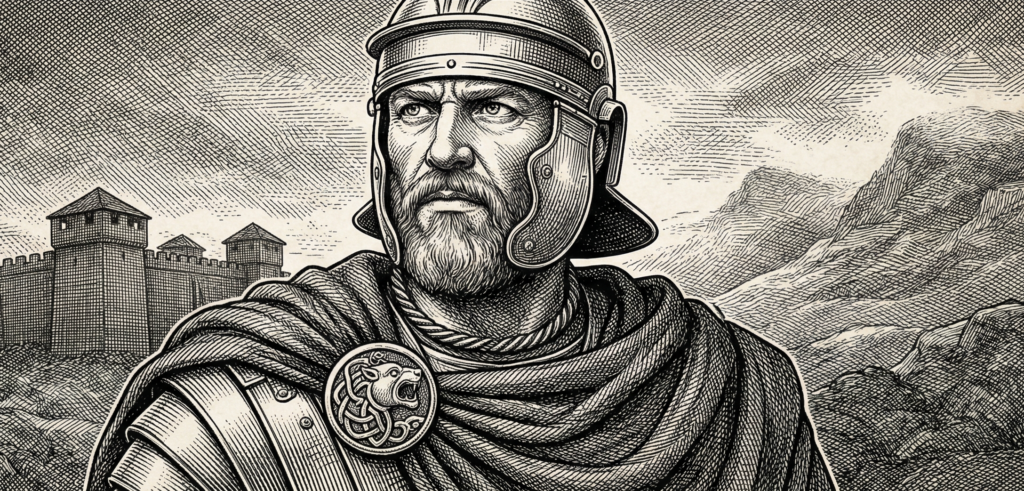
Padarn of the Scarlet Robe, Commander of the Votadini
Born ABT 325 · Died ABT 402
Biological parents
Step parents
No records listed yet.
Siblings
No records listed yet.
Half siblings
No records listed yet.
Spouse(s)
Children
No records listed yet.
Biography and reference links
Padarn Beisrudd ap Tegid, historically and mythologically renowned as “Paternus of the Scarlet Robe,” is a fascinating figure who stands at the misty crossroads of late Roman Britain and early Welsh legend. Born circa 305–325 BCE in the region known as Yr Hen Ogledd (the “Old North”), Padarn is celebrated not only as a formidable military commander but also as the foundational patriarch of one of Wales’ most powerful dynasties. His life bridges the era of Roman imperial control and the subsequent emergence of the sub-Roman Celtic kingdoms, making him a critical anchor in the genealogies of early Britain.
The name “Padarn Beisrudd” perfectly encapsulates his dual heritage. Padarn is the Brythonic derivation of the Latin Paternus, while Beisrudd translates to “of the Red Robe” or “Scarlet Tunic.” This colorful epithet is of immense historical significance; historians widely interpret the “scarlet robe” as the official purple or red cloak of a Roman administrator or high-ranking military officer. Padarn’s father, Tegid (derived from the Latin Tacitus), also bore a Romanized name, further suggesting that the family belonged to the Romano-British aristocracy.
In the late 4th century, Roman Britain faced increasing pressure from northern tribes, including the Picts. According to traditional interpretations, Padarn was appointed by the Roman Emperor Magnus Maximus or Macsen Wledig in Welsh tradition, in the 380s—or perhaps earlier by another Roman authority—to command the Votadini troops. The Votadini were a Celtic Iron Age tribe whose territory spanned from the Firth of Forth down to the River Tyne, encompassing modern-day Clackmannanshire, Lothian, and the Scottish Borders. Stationed in Manaw Gododdin, around modern Clackmannanshire in Scotland, Padarn was likely tasked with serving as a buffer against Pictish incursions from the north. Alternatively, he may have been an influential native frontier chieftain who was formally granted a Roman military rank, a common imperial practice to secure the loyalty of border tribes.
Padarn’s legacy, however, extends far beyond his command of the Votadini. He is an essential link in the royal genealogies compiled by medieval Welsh scribes, such as those found in the Harleian genealogies and the works of Lewys Dwnn. Padarn was the father of Edern (Aeturnus), who succeeded him in his command in the North. More famously, he was the grandfather of Cunedda Wledig. According to early Welsh tradition, it was Cunedda who later migrated south from Manaw Gododdin to North Wales with his followers to expel the invading Irish, ultimately founding the Kingdom of Gwynedd. Thus, Padarn Beisrudd is the distinguished forefather of the royal House of Gwynedd, a dynasty that would dominate Welsh history for centuries.
Beyond historical texts, Padarn of the Scarlet Robe also commands a place in Celtic mythology. His legendary scarlet tunic was counted among the “Thirteen Treasures of the Island of Britain.” According to lore, the coat perfectly fit any well-born man but would not fit a churl or commoner. The Life of Saint Padarn even includes a tale wherein the legendary King Arthur attempts to steal the tunic, highlighting Padarn’s elevated, almost mythic status in later British folklore.
Padarn passed away around 402 AD. Though his lifespan stretches the bounds of ancient longevity—some genealogical records tentatively trace his life to roughly 97 years—he remains an enduring symbol of a transformative epoch. From a Roman-appointed commander guarding the perilous northern frontiers of Britannia to the mythologized ancestor of the Welsh kings, Padarn Beisrudd represents the enduring legacy of Rome blending with the rising spirit of the Celtic nations.
External links
Gallery
Upload multiple images or documents from the WordPress editor using the Profile gallery box.
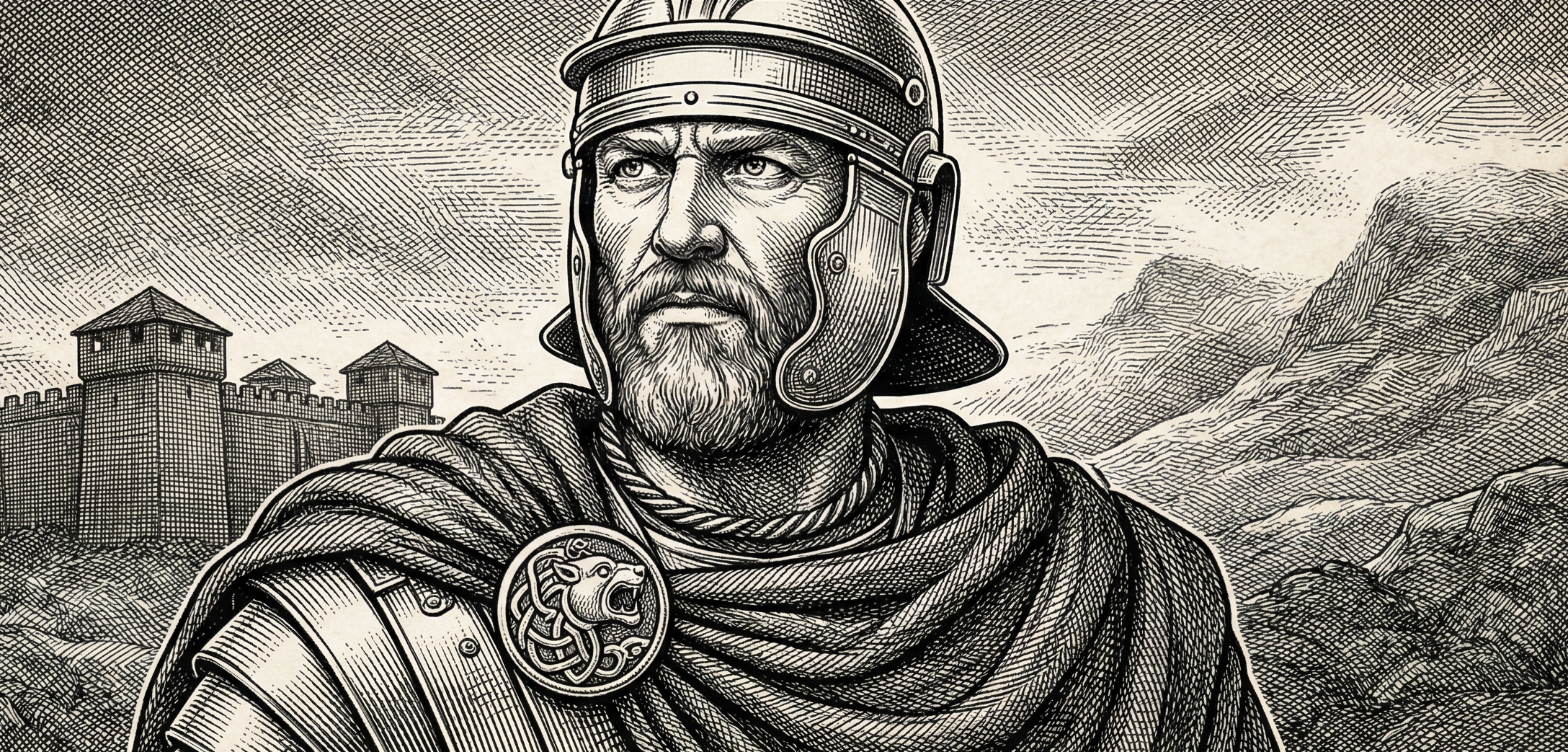
Life timeline
Timeline entries can be edited directly in the Life timeline box in the WordPress editor.
-
c. 325Birth
-
c. 402Death
-
MarriageSpouse: Gwawl Verch Coel
Movement map
This plots timeline locations with available latitude/longitude values. The bundled profiles include approximate coordinates where they could be inferred from the event place text, especially for immigrants and movers across states or countries.
Fan chart of ancestors
This view uses the imported ancestor branch for the notable record. Drag inside the frame to pan, and use the zoom controls or mouse wheel to inspect individual ancestor tiles.
Genealogical line to John Boone
This follows the descendant path used by the browser to connect the person back down to John “Johnny” Lafayette Franklin Boone.